Presented By: Earth and Environmental Sciences
Diana Velazquez Dissertation Defense
Organic Matter Burial and Preservation in Modern and Ancient Hypoxic Aquatic Environments
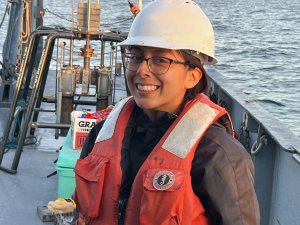

Lake sediments act as archives of environmental change, preserving geochemical signals that can be linked to local and global shifts in biogeochemical cycling throughout Earth’s history. Additionally, with approximately half as much organic carbon buried in lakes globally as in the world’s oceans, lake sediments are critical carbon reservoirs. However, prolonged lake stratification due to increasingly warming climate conditions, is resulting in extended periods of low-oxygen, hypoxic, conditions in lakes. Because hypoxic lake conditions favor oxygen-free microbial metabolisms, they can alter the mechanisms controlling sedimentary carbon sequestration. While anthropogenic influences on freshwater environments are profound, they represent only the most recent shifts in water column oxygenation. Earth’s history is marked by fluctuating oxygen conditions, transitioning from an anoxic atmosphere to an oxygenated one since 2.45 billion years ago. To understand modern shifts in carbon cycling and to better understand environmental change recorded in ancient lake sediments, it is imperative to trace lake organic matter sources, sinks, and burial mechanisms. Given that organic matter can be broken down and reworked during its transport and burial to sediments, this dissertation investigates how we can reliably capture original source signals and reconstruct ancient lake conditions.
Because our ability to reliably reconstruct past aquatic environments is determined by whether or not sediments faithfully record original source signals, Chapter 2 examines methodological approaches for the collection of organic matter in freshwaters. In this chapter, I use laboratory experiments to test how effectively chemical treatments preserve the original geochemical signatures of organic matter from a freshwater pond. Recommendations for the use of chemical treatments depend on the desired measurements and the length of the storage period. Notably, I find that freshwater organic matter retains its original geochemical signatures in the absence of chemical treatment over short periods which offers a low-toxicity and cost-effective alternative to methods commonly used to preserve marine material.
In Chapter 3, I apply methods from the previous chapter to identify organic matter sources and preservation processes in a modern hypoxic environment, Middle Island Sinkhole in Lake Huron. I integrate bulk and compound-specific geochemical approaches to understand sedimentary organic matter large scale and molecular-level transformations. I find that bulk measurements are often complicated by seasonal variability and microbial decomposition. Compound-specific approaches, however, resolve original source signals that can be valuable when analyzing sedimentary records of ancient lake systems.
Ultimately, I expand my understanding of organic matter preservation from a single low-oxygen site to lakes, globally in Chapter 4. By compiling lake sedimentary geochemical data from lakes worldwide and their water column oxygen conditions, I establish geochemical patterns related to oxygen. I use modern lake sedimentary patterns to trace the evolution of nitrogen microbial metabolisms that evolved from Earth’s oxygenation throughout the past 3.2 billion years. Beyond tracking changes in oxygen, lake sediments also provide insight into the chemistry of ancient lake waters.
Collectively, the work in this dissertation emphasizes lake sediments as natural recorders of local and global environmental transformations, particularly related to shifts in Earth’s oxygenation. This dissertation adds to the refinement of methodological approaches needed to reliably trace organic matter source-to-sink dynamics under a changing climate.
Because our ability to reliably reconstruct past aquatic environments is determined by whether or not sediments faithfully record original source signals, Chapter 2 examines methodological approaches for the collection of organic matter in freshwaters. In this chapter, I use laboratory experiments to test how effectively chemical treatments preserve the original geochemical signatures of organic matter from a freshwater pond. Recommendations for the use of chemical treatments depend on the desired measurements and the length of the storage period. Notably, I find that freshwater organic matter retains its original geochemical signatures in the absence of chemical treatment over short periods which offers a low-toxicity and cost-effective alternative to methods commonly used to preserve marine material.
In Chapter 3, I apply methods from the previous chapter to identify organic matter sources and preservation processes in a modern hypoxic environment, Middle Island Sinkhole in Lake Huron. I integrate bulk and compound-specific geochemical approaches to understand sedimentary organic matter large scale and molecular-level transformations. I find that bulk measurements are often complicated by seasonal variability and microbial decomposition. Compound-specific approaches, however, resolve original source signals that can be valuable when analyzing sedimentary records of ancient lake systems.
Ultimately, I expand my understanding of organic matter preservation from a single low-oxygen site to lakes, globally in Chapter 4. By compiling lake sedimentary geochemical data from lakes worldwide and their water column oxygen conditions, I establish geochemical patterns related to oxygen. I use modern lake sedimentary patterns to trace the evolution of nitrogen microbial metabolisms that evolved from Earth’s oxygenation throughout the past 3.2 billion years. Beyond tracking changes in oxygen, lake sediments also provide insight into the chemistry of ancient lake waters.
Collectively, the work in this dissertation emphasizes lake sediments as natural recorders of local and global environmental transformations, particularly related to shifts in Earth’s oxygenation. This dissertation adds to the refinement of methodological approaches needed to reliably trace organic matter source-to-sink dynamics under a changing climate.

Explore Similar Events
-
Loading Similar Events...
