Presented By: Ecology and Evolutionary Biology
EEB Tuesday Seminar Series - Speakers: Julia Boyle & Marianne Azevedo Silva
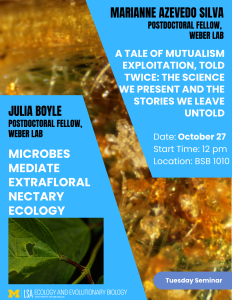

Speaker 1: Julia Boyle from Weber lab
Title: Microbes mediate extrafloral nectary ecology
Description: Plant-arthropod defense mutualisms involve specialized plant traits that provide food or shelter to arthropods in return for protection against natural enemies, including herbivores and pathogens. Two examples of such traits are extrafloral nectaries, plant organs that secrete sugary amino-acid-rich nectar to feed beneficial arthropods, and leaf domatia, small structures on the undersides of leaves that shelter predatory and fungivorous mites. Despite their widespread distribution and convergent evolution, little is known about how domatia and extrafloral nectaries interact with plant microbiomes, and whether microbes mediate the costs and benefits of these traits. Here, I combine field observations and manipulative common gardens to demonstrate that both microbes and mites play an underappreciated role in the ecology and evolution of extrafloral nectaries.
Speaker 2: Marianne Azevedo Silva from Weber lab
Title: A Tale of Mutualism Exploitation, Told Twice: The Science We Present and the Stories We Leave Untold
Description: In this talk, I will present a study investigating potential exploitation in one of the most ancient mutualisms between plants and arthropods: the plant–mite mutualism mediated by leaf domatia. Herbivorous eriophyid mites (often referred to as “gall mites”) have long been hypothesized to exploit this mutualism, yet this hypothesis has remained untested. By combining leaf observations with molecular data, I investigated whether the gall mite Acalitus ferrugineum acts as an exploiter of the domatia-mediated mutualism in American beech (Fagus grandifolia).
But this talk is about more than the scientific findings. I will tell the story of this research twice: first, as the polished, seemingly straightforward narrative we typically present at scientific conferences, and then as the much less predictable journey behind it. From the initial idea to unexpected challenges, changes in direction, and the decisions that ultimately shaped our findings, I will share some of the stories that scientific talks often leave untold.
Title: Microbes mediate extrafloral nectary ecology
Description: Plant-arthropod defense mutualisms involve specialized plant traits that provide food or shelter to arthropods in return for protection against natural enemies, including herbivores and pathogens. Two examples of such traits are extrafloral nectaries, plant organs that secrete sugary amino-acid-rich nectar to feed beneficial arthropods, and leaf domatia, small structures on the undersides of leaves that shelter predatory and fungivorous mites. Despite their widespread distribution and convergent evolution, little is known about how domatia and extrafloral nectaries interact with plant microbiomes, and whether microbes mediate the costs and benefits of these traits. Here, I combine field observations and manipulative common gardens to demonstrate that both microbes and mites play an underappreciated role in the ecology and evolution of extrafloral nectaries.
Speaker 2: Marianne Azevedo Silva from Weber lab
Title: A Tale of Mutualism Exploitation, Told Twice: The Science We Present and the Stories We Leave Untold
Description: In this talk, I will present a study investigating potential exploitation in one of the most ancient mutualisms between plants and arthropods: the plant–mite mutualism mediated by leaf domatia. Herbivorous eriophyid mites (often referred to as “gall mites”) have long been hypothesized to exploit this mutualism, yet this hypothesis has remained untested. By combining leaf observations with molecular data, I investigated whether the gall mite Acalitus ferrugineum acts as an exploiter of the domatia-mediated mutualism in American beech (Fagus grandifolia).
But this talk is about more than the scientific findings. I will tell the story of this research twice: first, as the polished, seemingly straightforward narrative we typically present at scientific conferences, and then as the much less predictable journey behind it. From the initial idea to unexpected challenges, changes in direction, and the decisions that ultimately shaped our findings, I will share some of the stories that scientific talks often leave untold.
Co-Sponsored By

Explore Similar Events
-
Loading Similar Events...
