Presented By: Earth and Environmental Sciences
Jeronimo Morales Toledo Dissertation Defense
Bridging Macroevolution and Ecology in the Arum Family (Araceae): Insights from Exceptionally Preserved Fossil and extantFruits
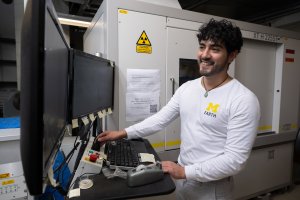

The Araceae is a diverse early divergent lineage within the monocotyledons. Today the family is present in most terrestrial biomes but in Antarctica, driven mostly by their diverse life-forms and reproductive biology. However, an integrative approach that involves morphological, paleontological, phylogenetic and ecological data to understand the deep roots evolution of Araceae is still lacking. In this dissertation, I address this gap by creating a reproductive morphological framework based on fruit and seeds to integrate the aroid reproductive fossil record in a time calibrated phylogeny. I performed a species level survey of aroid fruit and seed anatomy using X-ray micro-computed tomography (μCT) and scanned over 260 species representing nearly all extant genera of extant diversity. Using these scans, I created a morphological data set that was integrated with DNA sequence data to analyze the evolutionary relationships of six fossil species. With this, I re-evaluated systematics of exceptionally preserved fruits and seeds from the Cretaceous to the Paleogene.
In chapter 2 I evaluated the systematics of a fossil infructescence from the Late Cretaceous of South Dakota and used phylogenetic comparative methods to understand its relationship with modern aroids and understand the time and mode of the evolution of different life-forms across the Araceae tree of life.
Chapter 3 was focused on the structural reinterpretation of fossil fruits from the Paleogene of Northern Africa, and its implications on how extinction can prune former morphologies that are unreachable to see if we rely on extant data.
In the Chapter 4, I focused on advancing the understanding between reproductive fruit and seed aroid biology, their fossil record, and the diversity of life-forms in different sub families. The results of this integrative approach led me to the recognition of the reproductive fossil record of the family within a time-calibrated phylogeny. Additionally, the production of this new comparative morphological dataset, let us recognize the fruits are not strongly determined by the life-forms.
Overall, this dissertation contributes new data and insights into the tempo and mode of aroid evolution, with broader relevance to key questions on paleobiology, evolutionary biology, and Earth Sciences.
In chapter 2 I evaluated the systematics of a fossil infructescence from the Late Cretaceous of South Dakota and used phylogenetic comparative methods to understand its relationship with modern aroids and understand the time and mode of the evolution of different life-forms across the Araceae tree of life.
Chapter 3 was focused on the structural reinterpretation of fossil fruits from the Paleogene of Northern Africa, and its implications on how extinction can prune former morphologies that are unreachable to see if we rely on extant data.
In the Chapter 4, I focused on advancing the understanding between reproductive fruit and seed aroid biology, their fossil record, and the diversity of life-forms in different sub families. The results of this integrative approach led me to the recognition of the reproductive fossil record of the family within a time-calibrated phylogeny. Additionally, the production of this new comparative morphological dataset, let us recognize the fruits are not strongly determined by the life-forms.
Overall, this dissertation contributes new data and insights into the tempo and mode of aroid evolution, with broader relevance to key questions on paleobiology, evolutionary biology, and Earth Sciences.

Explore Similar Events
-
Loading Similar Events...
