Presented By: Center for Southeast Asian Studies
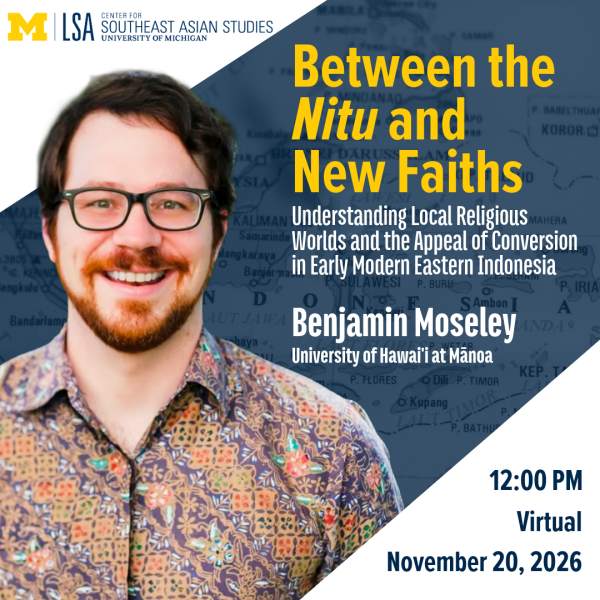
CSEAS Friday Lecture Series | Between the Nitu and New Faiths: Understanding Local Religious Worlds and the Appeal of Conversion in Early Modern Eastern Indonesia
Benjamin Moseley, University of Hawaiʻi at Mānoa

Please note: This lecture will be held virtually on Zoom. Registration is required. Once you've registered, joining information will be sent to your email. Register for the Zoom webinar at: https://myumi.ch/nVJ7b
Between the late fifteenth and early seventeenth centuries, the islands of Southeast Asia’s eastern archipelago—particularly those within Indonesia’s present-day provinces of Maluku, North Maluku, and East Nusa Tenggara—became the site of overlapping and competitive processes of Islamization and Christianization. The peoples of the region actively interpreted, adapted, and integrated these faiths within existing cultural, political, and spiritual frameworks. Understanding these encounters, however, requires reconstructing the religious worlds of communities that left few written records of their own. Scholars must therefore critically examine missionary and colonial accounts alongside nineteenth- and twentieth-century ethnographies, remaining attentive to observers’ biases and the historical changes separating these sources. Focusing on Ambon, North Maluku, and Flores, this talk explores how to uncover earlier understandings of relations between humans and spirits (nitu), ritual obligations, and cosmological dualism. It also considers how these understandings shaped the appeal of Islam and Christianity and the meanings of conversion, as people negotiated new teachings and practices alongside established beliefs and obligations.
BENJAMIN L. MOSELEY earned his PhD. in history from the University of Hawaiʻi at Mānoa in Spring 2026. His dissertation examined patterns of religious conversion and the relationships among Christianity, Islam, and local belief systems in early modern eastern Indonesia.
If there is anything we can do to make this event accessible to you, please contact us at [email protected]. Please be aware that advance notice is necessary as some accommodations may require more time for the university to arrange.
Related Links
Co-Sponsored By

Explore Similar Events
-
Loading Similar Events...
