Presented By: Earth and Environmental Sciences
Smith Lecture: Jena Johnson
Exploring Mineral Signals of Early Life through (Bio)geochemical Experiments
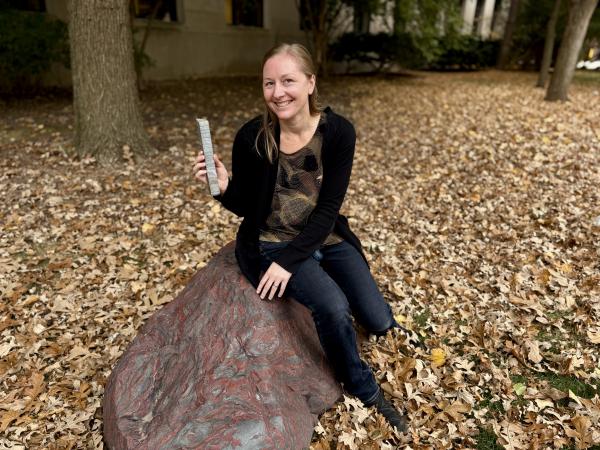

Earth's mineral record should capture evidence of the evolution of early microbes because microorganisms mediate diverse chemical reactions, including reactions that promote mineral precipitation. Banded Iron Formations (BIFs) are prominent iron- and silica-rich Archean marine sedimentary rocks that are interpreted as chemical precipitates that accumulated on the ocean floor from an anoxic ocean. BIFs now contain a diverse assemblage of iron minerals, with most better-preserved BIF cores dominated by magnetite, iron carbonates, iron silicates, and occasionally hematite. Identifying the primary IF precipitates should constrain the (bio)geochemical processes that formed the IFs and potentially shed light on the metabolisms of early life. While the original IF mineral was previously thought to be iron oxides, implying the involvement of light or oxygen to produce these iron-rich sediments, discoveries of iron silicate inclusions within early-silicifying chert in Archean IFs suggest that primary or very early minerals forming from the Archean oceans were actually iron silicates. Inferring the activities of early life from these BIF minerals requires testing the multiple possible (bio)chemical reactions suggested for BIF formation. Hypotheses for triggering the initial precipitation of Fe-Si precipitates range from abiotic chemical reactions related to pH changes to iron oxidation promoted by iron-oxidizing photosynthesis or trace levels of cyanobacterially-produced O2. Subsequently, Fe(III)-respiring microbes may have altered the initial BIF precipitates, helping to generate the more reduced minerals found in BIFs. We used laboratory experiments to systematically characterize the solid products of each of these putative mechanisms. Our results suggest that different mechanisms of iron oxidation from very similar solutions may produce radically different mixtures of Fe(II,III) phases, which can then serve as electron acceptors for iron-respiring microbes that transform these phases to secondary minerals. Ultimately, our mechanistic experiments help link BIF minerals to ancient life and reveal how the early iron-cycling world may have cycled electrons, iron, and carbon.

Explore Similar Events
-
Loading Similar Events...
