Presented By: Department of Statistics
Oral Prelim: Anwesha Bhattacharyya, A Bayesian Methodology for High-Dimensional Discrete Graphical Models

Abstract:
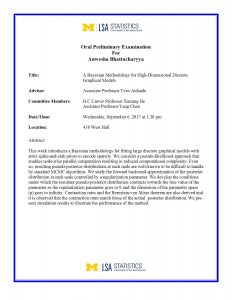
This work introduces a Bayesian methodology for fitting large discrete graphical models with strict spike-and-slab priors to encode sparsity. We consider a pseudo-likelihood approach that enables node-wise parallel computation resulting in reduced computational complexity. Even so, resulting pseudo-posterior distributions at each node are well-known to be difficult to handle by standard MCMC algorithms. We study the forward backward approximation of the posterior distribution at each node controlled by a regularization parameter. We develop the conditions under which the resultant pseudo-posterior distribution contracts towards the true value of the parameter as the regularization parameter goes to 0 and the dimension of the parameter space (p) goes to infinity. Contraction rates and the Bernstein-von Mises theorem are also derived and it is observed that the contraction rates match those of the actual posterior distribution. We present simulation results to illustrate the performance of the method.
This work introduces a Bayesian methodology for fitting large discrete graphical models with strict spike-and-slab priors to encode sparsity. We consider a pseudo-likelihood approach that enables node-wise parallel computation resulting in reduced computational complexity. Even so, resulting pseudo-posterior distributions at each node are well-known to be difficult to handle by standard MCMC algorithms. We study the forward backward approximation of the posterior distribution at each node controlled by a regularization parameter. We develop the conditions under which the resultant pseudo-posterior distribution contracts towards the true value of the parameter as the regularization parameter goes to 0 and the dimension of the parameter space (p) goes to infinity. Contraction rates and the Bernstein-von Mises theorem are also derived and it is observed that the contraction rates match those of the actual posterior distribution. We present simulation results to illustrate the performance of the method.
Co-Sponsored By

Explore Similar Events
-
Loading Similar Events...
