Presented By: Michigan Institute for Computational Discovery and Engineering
Margaret Cheung: Molecular Underpinning of Postsynaptic Calmodulin-dependent Calcium Signaling
MICDE Seminar Series
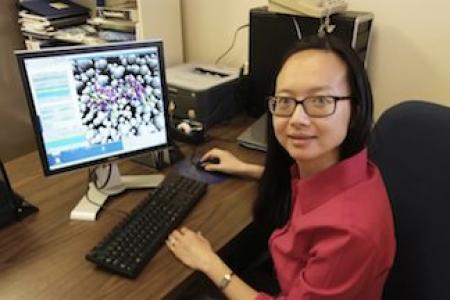
Calcium (Ca2• ) is exquisitely utilized by a cell for transducing external stimuli through its gradient of extracellular (~1000 μM) and intracellular (~0.1 μM) concentration. A broad spectrum of Ca2 signals are encoded by protein calmodulin (CaM) through specific binding with various targets regulating CaM-dependent Ca2• signaling pathways in neurons. I will focus on binding between CaM and two specific targets, Ca2/CaM-dependent protein kinase II (CaMKII) and neurogranin (Ng), as they antagonistically regulate CaM-dependent Ca2• signaling pathways in neurons. I will show the impact of bound calmodulin (CaM)-target compound structure on the affinity of calcium (Ca2) by integrating coarse-grained models and all-atomistic simulations with non-equilibrium physics. We discovered the molecular underpinnings of lowered affinity of Ca2• for CaM in the presence of Ng by showing that the N-terminal acidic region of Ng peptide pries open the β-sheet structure between the Ca2 binding loops particularly at C-domain of CaM, enabling Ca2• release. In contrast, CaMKII peptide increases Ca2 affinity for the C-domain of CaM by stabilizing the two Ca2• binding loops. Through distinctive structural differences in the bound complexes of apoCaM-Ng13-49 and holoCaM-CaMKII, CaM’s affinity for Ca2 is delineated by its progressive mechanism of target binding. I will discuss them in the context of evolution and in the crowded environment.
Bio: Margaret Cheung is an Associate Professor of Physics at the University of Houston. She graduated from the National Taiwan University with a bachelor’s degree in chemistry and received her Ph.D. in physics from the University of California, San Diego.
Bio: Margaret Cheung is an Associate Professor of Physics at the University of Houston. She graduated from the National Taiwan University with a bachelor’s degree in chemistry and received her Ph.D. in physics from the University of California, San Diego.
Related Links

Explore Similar Events
-
Loading Similar Events...
