Presented By: Eisenberg Institute for Historical Studies
EIHS Workshop: Identity-Making and the Environment
Bailey Franzoi, Katelin Mikos, Stephen Kolison, Meghan Looney, Ian Moyer (moderator)
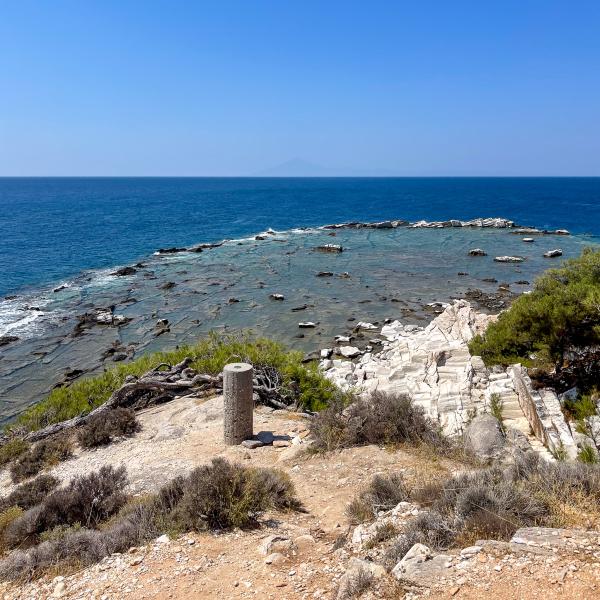

Humans are inherently entangled with and affected by the environmental landscapes in which they exist. Terrestrial, aquatic, and now even galactic environments are spaces of conquest, habitation, cultivation, and destruction. Moreover, these diverse environments play a large role in identity formation in these spaces.
For example, Paul Kosmin’s latest work, "The Ancient Shore," reframes the coast as a conceptual zone and the coastline as an unpredictable site with boundless possibilities. “The ancient shore was where the efforts of communal ordering and intellectual fabrication met the 'raw,' unassimilated environment most continuously and maximally. It was—and perhaps remains—the primary location for orienting ourselves to a natural world that is given to us without being intended for us (3).” Coasts provide a spatial and chronological liminality where political, cultural, scientific, and philosophical forms of knowledge were continuously invented and new identities claimed. This “spatial turn,” along with questions of identity-making, offers new insights into the study of environmental history and compels us to connect people, objects, states, ideas, and beliefs with places, spaces, and time in this light. In turn, this workshop will explore these intersections between identity-making and the environment.
This event presented by the Eisenberg Institute for Historical Studies. It is made possible in part by a generous contribution from Kenneth and Frances Aftel Eisenberg.
For example, Paul Kosmin’s latest work, "The Ancient Shore," reframes the coast as a conceptual zone and the coastline as an unpredictable site with boundless possibilities. “The ancient shore was where the efforts of communal ordering and intellectual fabrication met the 'raw,' unassimilated environment most continuously and maximally. It was—and perhaps remains—the primary location for orienting ourselves to a natural world that is given to us without being intended for us (3).” Coasts provide a spatial and chronological liminality where political, cultural, scientific, and philosophical forms of knowledge were continuously invented and new identities claimed. This “spatial turn,” along with questions of identity-making, offers new insights into the study of environmental history and compels us to connect people, objects, states, ideas, and beliefs with places, spaces, and time in this light. In turn, this workshop will explore these intersections between identity-making and the environment.
This event presented by the Eisenberg Institute for Historical Studies. It is made possible in part by a generous contribution from Kenneth and Frances Aftel Eisenberg.
Co-Sponsored By

Explore Similar Events
-
Loading Similar Events...
