Skip to Content

Sponsors

No results

Keywords

No results

Types

No results

Search Results

Events

No results
Search events using: keywords, sponsors, locations or event type
When / Where

Presented By: Nam Center for Korean Studies

Korean Cinema NOW | Voices | 목소리들
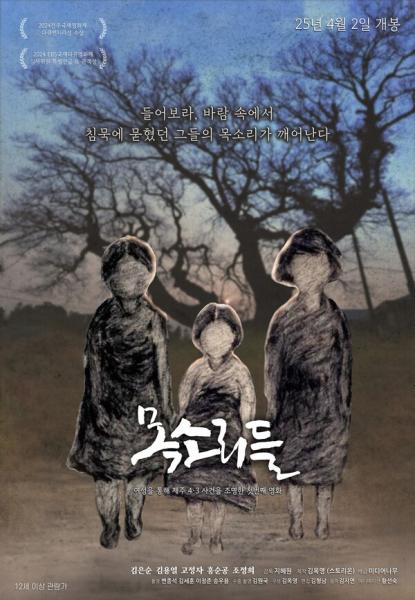
This emotionally charged poster is dominated by the dark silhouettes of three child-like figures standing side-by-side against a bleak, earthy backdrop of dead or skeletal trees and a dark, dramatic blue sky. The figures are rendered in a rough, textured, charcoal-like style, with indistinct faces, suggesting anonymous victims or historical figures. The central Korean title is "목소리들 (Voices)," and a powerful phrase is placed above the figures: "돌아보라, 바람 속에서 침묵에 묻혔던 그들의 목소리가 깨어난다" (Look back, in the wind, their voices that were buried in silence awaken). Text at the top references the film as being the first to illuminate the Jeju April 3rd Incident and its victims, indicating a heavy historical drama. The overall mood is somber, reflective, and focuses on remembrance and the uncovering of a tragic past. This emotionally charged poster is dominated by the dark silhouettes of three child-like figures standing side-by-side against a bleak, earthy backdrop of dead or skeletal trees and a dark, dramatic blue sky. The figures are rendered in a rough, textured, charcoal-like style, with indistinct faces, suggesting anonymous victims or historical figures. The central Korean title is "목소리들 (Voices)," and a powerful phrase is placed above the figures: "돌아보라, 바람 속에서 침묵에 묻혔던 그들의 목소리가 깨어난다" (Look back, in the wind, their voices that were buried in silence awaken). Text at the top references the film as being the first to illuminate the Jeju April 3rd Incident and its victims, indicating a heavy historical drama. The overall mood is somber, reflective, and focuses on remembrance and the uncovering of a tragic past.
This emotionally charged poster is dominated by the dark silhouettes of three child-like figures standing side-by-side against a bleak, earthy backdrop of dead or skeletal trees and a dark, dramatic blue sky. The figures are rendered in a rough, textured, charcoal-like style, with indistinct faces, suggesting anonymous victims or historical figures. The central Korean title is "목소리들 (Voices)," and a powerful phrase is placed above the figures: "돌아보라, 바람 속에서 침묵에 묻혔던 그들의 목소리가 깨어난다" (Look back, in the wind, their voices that were buried in silence awaken). Text at the top references the film as being the first to illuminate the Jeju April 3rd Incident and its victims, indicating a heavy historical drama. The overall mood is somber, reflective, and focuses on remembrance and the uncovering of a tragic past.
2025 ‧ Documentary ‧ 1h 29min ‧ Unrated

View the trailer at: https://www.youtube.com/watch?v=Xg5q85vC3zE

The 2024 documentary Voices is a profound and essential South Korean film directed by Jee Hyewon that illuminates the long-silenced experiences of the female survivors of the Jeju 4.3 Incident—a series of brutal anti-communist suppression campaigns and massacres that took place on Jeju Island from 1948 to 1954. The film meticulously gathers testimonies from the women, many of whom were young at the time, detailing the violence, the loss of family members, and the decades of trauma and stigma they carried in silence. By focusing on these women, including the island's famous haenyeo (female free divers), the documentary provides a vital, underrepresented perspective on a painful chapter of Korean history. Voices was a critical success on the festival circuit, winning the Documentary Award in the Special Awards category at the 25th Jeonju International Film Festival in 2024.

Directed by Ji Hye-won
Presented in Korean with English subtitles

Accommodation: If there is anything we can do to make this event accessible to you, please contact us at outreachkorea@umich.edu. Please be aware that advance notice is necessary as some accommodations may require more time for the university to arrange.
This emotionally charged poster is dominated by the dark silhouettes of three child-like figures standing side-by-side against a bleak, earthy backdrop of dead or skeletal trees and a dark, dramatic blue sky. The figures are rendered in a rough, textured, charcoal-like style, with indistinct faces, suggesting anonymous victims or historical figures. The central Korean title is "목소리들 (Voices)," and a powerful phrase is placed above the figures: "돌아보라, 바람 속에서 침묵에 묻혔던 그들의 목소리가 깨어난다" (Look back, in the wind, their voices that were buried in silence awaken). Text at the top references the film as being the first to illuminate the Jeju April 3rd Incident and its victims, indicating a heavy historical drama. The overall mood is somber, reflective, and focuses on remembrance and the uncovering of a tragic past. This emotionally charged poster is dominated by the dark silhouettes of three child-like figures standing side-by-side against a bleak, earthy backdrop of dead or skeletal trees and a dark, dramatic blue sky. The figures are rendered in a rough, textured, charcoal-like style, with indistinct faces, suggesting anonymous victims or historical figures. The central Korean title is "목소리들 (Voices)," and a powerful phrase is placed above the figures: "돌아보라, 바람 속에서 침묵에 묻혔던 그들의 목소리가 깨어난다" (Look back, in the wind, their voices that were buried in silence awaken). Text at the top references the film as being the first to illuminate the Jeju April 3rd Incident and its victims, indicating a heavy historical drama. The overall mood is somber, reflective, and focuses on remembrance and the uncovering of a tragic past.
This emotionally charged poster is dominated by the dark silhouettes of three child-like figures standing side-by-side against a bleak, earthy backdrop of dead or skeletal trees and a dark, dramatic blue sky. The figures are rendered in a rough, textured, charcoal-like style, with indistinct faces, suggesting anonymous victims or historical figures. The central Korean title is "목소리들 (Voices)," and a powerful phrase is placed above the figures: "돌아보라, 바람 속에서 침묵에 묻혔던 그들의 목소리가 깨어난다" (Look back, in the wind, their voices that were buried in silence awaken). Text at the top references the film as being the first to illuminate the Jeju April 3rd Incident and its victims, indicating a heavy historical drama. The overall mood is somber, reflective, and focuses on remembrance and the uncovering of a tragic past.

Explore Similar Events

  •  Loading Similar Events...

Back to Main Content