Presented By: Center for Connected and Automated Transportation
Rare Failures, Public Perception, and Automated Driving: Why Exceptional Events Shape Trust in Emerging Safety Technologies
Professor Daniel V. McGehee
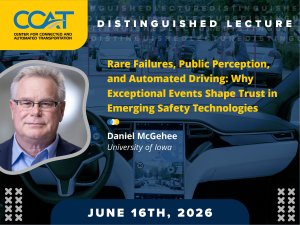

This lecture explores the “vaccine paradox” of automated driving: why rare, highly publicized failures of self-driving vehicles provoke intense emotional and political reactions while the far more common harms of human driving remain normalized. Drawing on risk psychology, public-health history, and human-factors research, Prof. McGehee examines how visibility imbalance, trust, and perceptions of control shape public acceptance of emerging vehicle automation. Using real-world examples from automated-vehicle deployments alongside lessons from vaccine adoption and safety communication, the talk argues that societal expectations for perfection in automation may obscure meaningful population-level safety gains. The presentation concludes by discussing how transparency, responsible system design, and careful language around driver-assistance technologies can help align public perception with evidence as automated driving evolves toward broader deployment.
---
About the speaker: Daniel V. McGehee, is Professor of Industrial and Systems Engineering at the University of Iowa and Director of the Driving Safety Research Institute (DSRI) and the National Advanced Driving Simulator (NADS), one of the world’s largest and most advanced ground-vehicle simulation facilities. For more than three decades, his work has focused on human factors, driver behavior, and the safe integration of advanced vehicle technologies, including automated driving and driver-assistance systems. Dr. McGehee’s research spans engineering, medicine, public health, and transportation policy, with projects funded by the U.S. Department of Transportation, National Institutes of Health, and the automotive industry. He has led over $40 million in sponsored research and authored more than 160 scientific publications addressing driver attention, crash avoidance, vulnerable road users, and the design of vehicle interfaces. His work combines naturalistic driving studies, simulation, and field research to better understand how humans interact with emerging mobility systems. At the University of Iowa, he holds joint appointments in emergency medicine and public health, reflecting his longstanding interest in traffic safety as a population-level health issue.
---
About the speaker: Daniel V. McGehee, is Professor of Industrial and Systems Engineering at the University of Iowa and Director of the Driving Safety Research Institute (DSRI) and the National Advanced Driving Simulator (NADS), one of the world’s largest and most advanced ground-vehicle simulation facilities. For more than three decades, his work has focused on human factors, driver behavior, and the safe integration of advanced vehicle technologies, including automated driving and driver-assistance systems. Dr. McGehee’s research spans engineering, medicine, public health, and transportation policy, with projects funded by the U.S. Department of Transportation, National Institutes of Health, and the automotive industry. He has led over $40 million in sponsored research and authored more than 160 scientific publications addressing driver attention, crash avoidance, vulnerable road users, and the design of vehicle interfaces. His work combines naturalistic driving studies, simulation, and field research to better understand how humans interact with emerging mobility systems. At the University of Iowa, he holds joint appointments in emergency medicine and public health, reflecting his longstanding interest in traffic safety as a population-level health issue.
Co-Sponsored By

Explore Similar Events
-
Loading Similar Events...
