Presented By: Single Cell Spatial Analysis Program (SCSAP)
Single Cell Spatial Analysis Monthly Seminar Series
Featuring: Samouil L. Farhi, Ph.D. Director of the Spatial Technology Platform, Broad Institute of MIT and Harvard
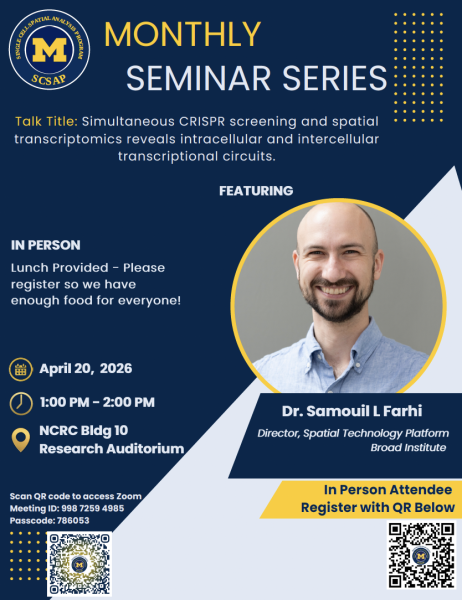

TITLE: Simultaneous CRISPR screening and spatial transcriptomics reveals intracellular and intercellular transcriptional circuits.
FEATURING:
Samouil L. Farhi, Ph.D. Director of the Spatial Technology Platform at the Broad Institute of MIT and Harvard
For more details Visit: https://singlecellspatialanalysis.umich.edu/monthlyseminarseries/
Zoom Info:
Meeting ID: 998 7259 4985
Passcode: 786053
ABSTRACT:
Perturb-FISH combines spatial transcriptomics with optical detection of in situ amplified guide RNAs. Perturb-FISH recovers intracellular effects that are consistent with Perturb-seq results in cultured monocytes, and finds density-dependent regulation of the innate immune response. Pairing Perturb-FISH with a functional readout in a screen of autism spectrum disorder risk genes, shows common calcium activity phenotypes in induced pluripotent stem cell derived astrocytes and their associated molecular pathways. Finally, Perturb-FISH can identify neighborhood dependent perturbation effects in a complex tissue by showing immune-tumor interactions in a xenograft model engrafted with human PBMCs. Perturb-FISH is thus a general method for studying the genetic and molecular associations of spatial and functional biology at single-cell resolution.
FEATURING:
Samouil L. Farhi, Ph.D. Director of the Spatial Technology Platform at the Broad Institute of MIT and Harvard
For more details Visit: https://singlecellspatialanalysis.umich.edu/monthlyseminarseries/
Zoom Info:
Meeting ID: 998 7259 4985
Passcode: 786053
ABSTRACT:
Perturb-FISH combines spatial transcriptomics with optical detection of in situ amplified guide RNAs. Perturb-FISH recovers intracellular effects that are consistent with Perturb-seq results in cultured monocytes, and finds density-dependent regulation of the innate immune response. Pairing Perturb-FISH with a functional readout in a screen of autism spectrum disorder risk genes, shows common calcium activity phenotypes in induced pluripotent stem cell derived astrocytes and their associated molecular pathways. Finally, Perturb-FISH can identify neighborhood dependent perturbation effects in a complex tissue by showing immune-tumor interactions in a xenograft model engrafted with human PBMCs. Perturb-FISH is thus a general method for studying the genetic and molecular associations of spatial and functional biology at single-cell resolution.
Related Links

Explore Similar Events
-
Loading Similar Events...
