Presented By: Eisenberg Institute for Historical Studies
EIHS Lecture: The Transatlantic Slave Trade & the (Multi) Racial Origins of Early Black Print in Ghana
Carina Ray (University of Michigan)

Understanding how Afro-Europeans came to play leading roles in establishing the African-owned press in colonial Ghana, and why they introduced race as the primary language of political protest in their newspapers requires reaching back to the late fifteenth century when the social world of the transatlantic slave trade first began to take shape. Two features of this social world—interracial sexual relationships between African women and European men and the concomitant growth of an Afro-European population that remained embedded in African society—were key drivers of the process of racialization unleashed by the transatlantic slave trade. This process would evolve over the course of four centuries in ways that gave Afro-European men the social positionality, financial resources, and political impetus to be the first founders of African-owned newspapers in colonial Ghana. Their newspapers reveal a late-nineteenth-century West African epistemology of blackness that stretched beyond its elite (primarily) Afro-European origins as literacy rates grew, newspaper publishing expanded, and the language of race became a politically consequential medium in the twentieth century that enabled dissent and shaped how Africans in the colony’s growing public sphere debated and fought for political futures defined not by their colonizers, but by themselves.
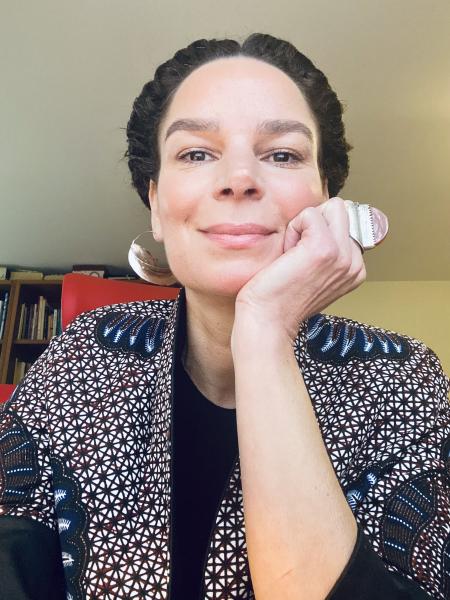
Carina Ray is a scholar of race and sexuality; comparative colonialisms and nationalisms; migration and maritime history; print cultures; bodily aesthetics, and the relationship between race, ethnicity, and political power. Ray’s research is primarily focused on Ghana and its diasporas. She is the author of Crossing the Color Line: Race, Sex, and the Contested Politics of Colonialism in Ghana, winner of the American Historical Association's 2016 Wesley-Logan Book Prize and the African Studies Association's 2017 Aidoo-Snyder Book Prize. Her articles have appeared in Gender and History, PMLA, The Journal of West African History, and The American Historical Review, among others. She is series co-editor of New African Histories (Ohio University Press) with Jacob Dlamini and Derek Peterson, and African Identities: Past and Present (Cambridge University Press) with Toyin Falola. Ray previously served as series editor of Ohio Short Histories of Africa (Ohio University Press) with Dan Magaziner, Michelle Moyd, and Moses Ochunu; as editor of Ghana Studies; and as a member of the Board of Editors for The American Historical Review.
This event presented by the Eisenberg Institute for Historical Studies. It is made possible in part by a generous contribution from Kenneth and Frances Aftel Eisenberg.
Carina Ray is a scholar of race and sexuality; comparative colonialisms and nationalisms; migration and maritime history; print cultures; bodily aesthetics, and the relationship between race, ethnicity, and political power. Ray’s research is primarily focused on Ghana and its diasporas. She is the author of Crossing the Color Line: Race, Sex, and the Contested Politics of Colonialism in Ghana, winner of the American Historical Association's 2016 Wesley-Logan Book Prize and the African Studies Association's 2017 Aidoo-Snyder Book Prize. Her articles have appeared in Gender and History, PMLA, The Journal of West African History, and The American Historical Review, among others. She is series co-editor of New African Histories (Ohio University Press) with Jacob Dlamini and Derek Peterson, and African Identities: Past and Present (Cambridge University Press) with Toyin Falola. Ray previously served as series editor of Ohio Short Histories of Africa (Ohio University Press) with Dan Magaziner, Michelle Moyd, and Moses Ochunu; as editor of Ghana Studies; and as a member of the Board of Editors for The American Historical Review.
This event presented by the Eisenberg Institute for Historical Studies. It is made possible in part by a generous contribution from Kenneth and Frances Aftel Eisenberg.
Co-Sponsored By

Explore Similar Events
-
Loading Similar Events...
