Presented By: Department of Afroamerican and African Studies
DAAS Faculty Forum with Justine Davis, Assistant Professor of Afroamerican and African Studies and Political Science
Dual Citizenship & Dueling Loyalties: Perceptions of Politicians from the Diaspora
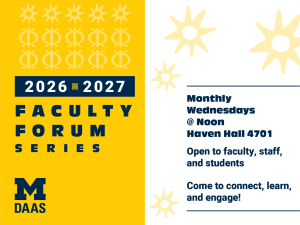

Faculty members of the Department of Afroamerican and African Studies discuss their projects, research, and publications to share their work and interests. The DAAS Faculty Forum will be held monthly on Wednesdays at noon.
October 21: Justine Davis, Assistant Professor of Afroamerican and African Studies; Assistant Professor of Political Science
Dual Citizenship & Dueling Loyalties: Perceptions of Politicians from the Diaspora
Abstract:
How do citizens perceive and respond to dual citizenship and diaspora policies, particularly pertaining to politicians who have ties to multiple countries? This project entails a multi-country survey and experimental design in Côte d'Ivoire and Liberia on public opinion about dual citizenship. Given the growing political and economic influence of the African diaspora, the rights and roles of dual citizens have become increasingly contentious. Using a descriptive survey and a conjoint experiment, we explore when and why citizens support dual citizenship, how they respond to diaspora politicians, and how they view the role dual citizens and the broader diaspora play in the economic and democratic development of their countries.
Bio:
I am an assistant professor jointly appointed in the Department of Afroamerican and African Studies (DAAS) and the Political Science Department at the University of Michigan. Prior to this position, I was a postdoctoral fellow at the University of Michigan and a UC Presidential Postdoctoral Fellow at the University of California, San Diego. I received my Ph.D. in Political Science from the University of California, Berkeley.
I study comparative politics and political behavior, focusing on sub-Saharan Africa. In particular, I am interested in the challenges of democratization efforts in post-conflict settings and weakly institutionalized democracies.
My book, No Neutral Ground, forthcoming with Cambridge University Press, examines the role of non-governmental organizations in fostering democracy after civil war.
My research has been supported by the Carnegie Corporation; the National Science Foundation; the West Africa Research Association; the Human Rights Center at UC Berkeley; and the Center for African Studies, the Peder Sather Center for Advanced Study, and the Institute for International Studies at UC Berkeley. My work has been featured on the Washington Post’s Monkey Cage and published or forthcoming in African Affairs, Comparative Political Studies, Journal of Conflict Resolution, Journal of Politics, Party Politics, Political Behavior, and PS: Political Science & Politics.
At the University of Michigan, I am an associate at the African Studies Center and a faculty associate at the Center for Political Studies. I am a member of Evidence and Governance in Politics, a research associate at the Center on the Politics of Development, a co-coordinator of the Midwest Workshop in Empirical Political Science, a Ford Foundation Pre-Doctoral Fellow, and an APSA Diversity Fellow. I was also part of the 2023 Inaugural Class for The Center for Advanced Study in the Behavioral Sciences (CASBS), Summer Institute on Diversity Science, at Stanford University.
Prior to obtaining my Ph.D., I completed a Fulbright-Clinton Public Policy Fellowship in Côte d’Ivoire. I hold a dual-language Master's degree in International Affairs, Conflict Resolution and Civil Society Development from the American University of Paris and the Université de Paris 1 Panthéon-Sorbonne. Originally from North Carolina, I graduated from Elon University with a Bachelor's degree in International Studies, African concentration.
Overall, I have experience living and working in France, Côte d'Ivoire, Ghana, Senegal, and I have also conducted fieldwork in Zambia and Benin.
November 18: Martin Murray, Adjunct Professor of Afroamerican and African Studies; Professor of Urban and Regional Planning, Alfred Taubman College of Architecture and Urban Planning
October 21: Justine Davis, Assistant Professor of Afroamerican and African Studies; Assistant Professor of Political Science
Dual Citizenship & Dueling Loyalties: Perceptions of Politicians from the Diaspora
Abstract:
How do citizens perceive and respond to dual citizenship and diaspora policies, particularly pertaining to politicians who have ties to multiple countries? This project entails a multi-country survey and experimental design in Côte d'Ivoire and Liberia on public opinion about dual citizenship. Given the growing political and economic influence of the African diaspora, the rights and roles of dual citizens have become increasingly contentious. Using a descriptive survey and a conjoint experiment, we explore when and why citizens support dual citizenship, how they respond to diaspora politicians, and how they view the role dual citizens and the broader diaspora play in the economic and democratic development of their countries.
Bio:
I am an assistant professor jointly appointed in the Department of Afroamerican and African Studies (DAAS) and the Political Science Department at the University of Michigan. Prior to this position, I was a postdoctoral fellow at the University of Michigan and a UC Presidential Postdoctoral Fellow at the University of California, San Diego. I received my Ph.D. in Political Science from the University of California, Berkeley.
I study comparative politics and political behavior, focusing on sub-Saharan Africa. In particular, I am interested in the challenges of democratization efforts in post-conflict settings and weakly institutionalized democracies.
My book, No Neutral Ground, forthcoming with Cambridge University Press, examines the role of non-governmental organizations in fostering democracy after civil war.
My research has been supported by the Carnegie Corporation; the National Science Foundation; the West Africa Research Association; the Human Rights Center at UC Berkeley; and the Center for African Studies, the Peder Sather Center for Advanced Study, and the Institute for International Studies at UC Berkeley. My work has been featured on the Washington Post’s Monkey Cage and published or forthcoming in African Affairs, Comparative Political Studies, Journal of Conflict Resolution, Journal of Politics, Party Politics, Political Behavior, and PS: Political Science & Politics.
At the University of Michigan, I am an associate at the African Studies Center and a faculty associate at the Center for Political Studies. I am a member of Evidence and Governance in Politics, a research associate at the Center on the Politics of Development, a co-coordinator of the Midwest Workshop in Empirical Political Science, a Ford Foundation Pre-Doctoral Fellow, and an APSA Diversity Fellow. I was also part of the 2023 Inaugural Class for The Center for Advanced Study in the Behavioral Sciences (CASBS), Summer Institute on Diversity Science, at Stanford University.
Prior to obtaining my Ph.D., I completed a Fulbright-Clinton Public Policy Fellowship in Côte d’Ivoire. I hold a dual-language Master's degree in International Affairs, Conflict Resolution and Civil Society Development from the American University of Paris and the Université de Paris 1 Panthéon-Sorbonne. Originally from North Carolina, I graduated from Elon University with a Bachelor's degree in International Studies, African concentration.
Overall, I have experience living and working in France, Côte d'Ivoire, Ghana, Senegal, and I have also conducted fieldwork in Zambia and Benin.
November 18: Martin Murray, Adjunct Professor of Afroamerican and African Studies; Professor of Urban and Regional Planning, Alfred Taubman College of Architecture and Urban Planning
Related Links

Explore Similar Events
-
Loading Similar Events...
