Presented By: African Studies Center
ASC Film Screening & Panel | Nigeria’s 2027 Elections and the Future of Democracy in Africa
Ose Oyamendan, Nigerian-American filmmaker and journalist; Omolade Adunbi, U-M; Jenna Bednar, U-M, Adrian Deese, U-M
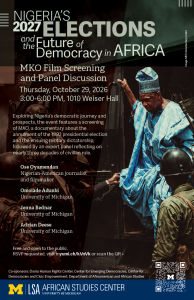

In anticipation of Nigeria’s 2027 general election, the African Studies Center (ASC) is organizing “Nigeria’s 2027 Elections and the Future of Democracy in Africa: Film Screening and Panel Discussion.” The program will examine Nigeria’s democratic journey and prospects through a screening of MKO, a recently released documentary about the annulment of the 1993 presidential election and the military dictatorship that followed, followed by a featured panel discussion on nearly three decades of civilian rule.
The panel will feature Nigerian-American filmmaker and journalist Ose Oyamendan, who covered the 1993 election and participated in the protests that followed the annulment of its results, along with faculty and colleagues from Political Science, the Department of Afroamerican and African Studies (DAAS), and the African Studies Center. The discussion will invite panelists to reflect on the historical significance of the 1993 election, the evolution of Nigerian democracy since the transition to civilian rule, and the opportunities and challenges ahead. A dinner for the panelists will follow the program.
MKO (2026)
Documentary, 108 minutes (1 hour and 48 minutes)
Director: Ose Oyamendan
MKO, directed by Nigerian-American filmmaker Ose Oyamendan, explores the life, political struggle, and controversial death of Moshood Kashimawo Olawale Abiola, popularly known as M. K. O. Abiola.
Chief Moshood Kashimawo Olawale Abiola, GCFR, was a Nigerian business magnate, publisher, philanthropist, and politician. In June 1993, he ran for president and won an election widely regarded as free and fair, but Nigeria’s military government annulled the results. The annulment prompted nationwide protests, the extrajudicial killing of protesters, and the detention of activists, including Abiola. He later died in military custody on July 7, 1998, under controversial circumstances. His death helped catalyze the dismantling of military rule and Nigeria’s return to civilian democratic governance.
Panel Discussion:
Ose Oyamendan, Nigerian-American journalist and filmmaker
Omolade Adunbi, ASC Director and Professor of Afroamerican and African Studies/Anthropology/Law, University of Michigan
Jenna Bednar, Professor of Political Science, University of Michigan
Adrian Deese, Assistant Professor of Afroamerican and African Studies, University of Michigan
Bios:
Ose Oyamendan is a Nigerian-American filmmaker based between Los Angeles, Lagos, and London. His debut feature is the critically acclaimed and award-winning documentary Aswat Acherim, which explores unlikely war zone friendships between residents of Sderot, an Israeli village, and their neighbors in Gaza. His sophomore film, MKO, debuted to critical acclaim at the 2026 Sheffield International Documentary Film Festival. Since graduating with an MFA, Ose has directed a few dozen commercials, short films, and documentary films in the USA, Africa, Europe, and the Middle East. He is an award winner at Tribeca, Rome, and Houston Worldfest film festivals. His projects have been shown all over the world in theaters, on television, and on streaming platforms.
Omolade Adunbi is a political and environmental anthropologist and professor of Afroamerican and African Studies in the Department of Afroamerican and African Studies (DAAS). His research examines the dynamics of power, natural resource extractive practices, governance, human and environmental rights, culture, transnational institutions, multinational corporations, and the postcolonial state.
Jenna Bednar is a professor of political science at the University of Michigan. Her research focuses on the analysis of institutions, with a focus on the theoretical underpinnings of the stability of federal states. Her most recent book, The Robust Federation, demonstrates how complementary institutions maintain and adjust the distribution of authority between national and state governments.
Adrian M. Deese is an assistant professor of Afroamerican and African studies at the University of Michigan. He completed a PhD in religious studies at the University of Cambridge in England. His research focuses on religious diversity and interreligious dialogue in nineteenth-century West Africa.
Co-sponsors: Donia Human Rights Center, Center for Emerging Democracies, Center for Democracies and Civic Empowerment, Department of Afroamerican and African Studies
- - - -
If there is anything we can do to make this event accessible to you, please contact us. Please be aware that advance notice is necessary as some accommodations may require more time for the university to arrange. Email Contact: [email protected]
The panel will feature Nigerian-American filmmaker and journalist Ose Oyamendan, who covered the 1993 election and participated in the protests that followed the annulment of its results, along with faculty and colleagues from Political Science, the Department of Afroamerican and African Studies (DAAS), and the African Studies Center. The discussion will invite panelists to reflect on the historical significance of the 1993 election, the evolution of Nigerian democracy since the transition to civilian rule, and the opportunities and challenges ahead. A dinner for the panelists will follow the program.
MKO (2026)
Documentary, 108 minutes (1 hour and 48 minutes)
Director: Ose Oyamendan
MKO, directed by Nigerian-American filmmaker Ose Oyamendan, explores the life, political struggle, and controversial death of Moshood Kashimawo Olawale Abiola, popularly known as M. K. O. Abiola.
Chief Moshood Kashimawo Olawale Abiola, GCFR, was a Nigerian business magnate, publisher, philanthropist, and politician. In June 1993, he ran for president and won an election widely regarded as free and fair, but Nigeria’s military government annulled the results. The annulment prompted nationwide protests, the extrajudicial killing of protesters, and the detention of activists, including Abiola. He later died in military custody on July 7, 1998, under controversial circumstances. His death helped catalyze the dismantling of military rule and Nigeria’s return to civilian democratic governance.
Panel Discussion:
Ose Oyamendan, Nigerian-American journalist and filmmaker
Omolade Adunbi, ASC Director and Professor of Afroamerican and African Studies/Anthropology/Law, University of Michigan
Jenna Bednar, Professor of Political Science, University of Michigan
Adrian Deese, Assistant Professor of Afroamerican and African Studies, University of Michigan
Bios:
Ose Oyamendan is a Nigerian-American filmmaker based between Los Angeles, Lagos, and London. His debut feature is the critically acclaimed and award-winning documentary Aswat Acherim, which explores unlikely war zone friendships between residents of Sderot, an Israeli village, and their neighbors in Gaza. His sophomore film, MKO, debuted to critical acclaim at the 2026 Sheffield International Documentary Film Festival. Since graduating with an MFA, Ose has directed a few dozen commercials, short films, and documentary films in the USA, Africa, Europe, and the Middle East. He is an award winner at Tribeca, Rome, and Houston Worldfest film festivals. His projects have been shown all over the world in theaters, on television, and on streaming platforms.
Omolade Adunbi is a political and environmental anthropologist and professor of Afroamerican and African Studies in the Department of Afroamerican and African Studies (DAAS). His research examines the dynamics of power, natural resource extractive practices, governance, human and environmental rights, culture, transnational institutions, multinational corporations, and the postcolonial state.
Jenna Bednar is a professor of political science at the University of Michigan. Her research focuses on the analysis of institutions, with a focus on the theoretical underpinnings of the stability of federal states. Her most recent book, The Robust Federation, demonstrates how complementary institutions maintain and adjust the distribution of authority between national and state governments.
Adrian M. Deese is an assistant professor of Afroamerican and African studies at the University of Michigan. He completed a PhD in religious studies at the University of Cambridge in England. His research focuses on religious diversity and interreligious dialogue in nineteenth-century West Africa.
Co-sponsors: Donia Human Rights Center, Center for Emerging Democracies, Center for Democracies and Civic Empowerment, Department of Afroamerican and African Studies
- - - -
If there is anything we can do to make this event accessible to you, please contact us. Please be aware that advance notice is necessary as some accommodations may require more time for the university to arrange. Email Contact: [email protected]
Related Links

Explore Similar Events
-
Loading Similar Events...
