Presented By: University Library
From Printed Page to Research Data: Building Humanities Tools with AI Agents
Deep Dive into Digital and Data Methods for Chinese Studies
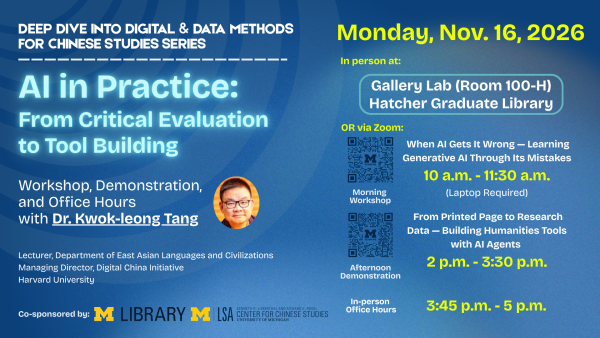

Attend a live demonstration, where Kwok-leong Tang, Harvard University, shows how AI coding agents, such as Claude Code, let a humanist build research tools by describing them in plain language, without being a trained programmer.
Attend in person or register to join via Zoom (https://myumi.ch/Ax23x). No laptop or setup is needed for in-person attendees.
The main demonstration is a full pipeline that turns printed materials into structured data: scanned pages go through OCR (turning page images into text), and the text then becomes a table of people, places, and dates, each checked against reference databases such as Wikidata and CBDB (China Biographical Database Project). Dr. Tang will also show other tools he has built this way, including a batch OCR tool, a converter for historical Chinese, Japanese, and Korean dates, a tool that suggests Library of Congress subject headings, and classroom history games made from primary sources. Throughout, we will look at how to check the agent's work and where this approach breaks down.
Following the demonstration, 3:45-5:00 pm, Dr. Tang will host an optional office hour for in-person participants who are interested in discussing their own projects related to AI and East Asian studies. This informal session offers an opportunity to receive feedback, explore possible approaches, and consider both the potential and limitations of AI tools for your projects.
Related Links
Co-Sponsored By

Livestream Information
LivestreamNovember 16, 2026 (Monday) 2:00pm
Joining Information Not Yet Available
Explore Similar Events
-
Loading Similar Events...
