Presented By: U-M College of Pharmacy
Vaccine Durability – what have we learned so far?
U-M College of Pharmacy Pharmaceutical Sciences John G. Wagner Pharmacia & Upjohn Memorial Lecture Series: Dr. Mark Slifka, Ph.D.
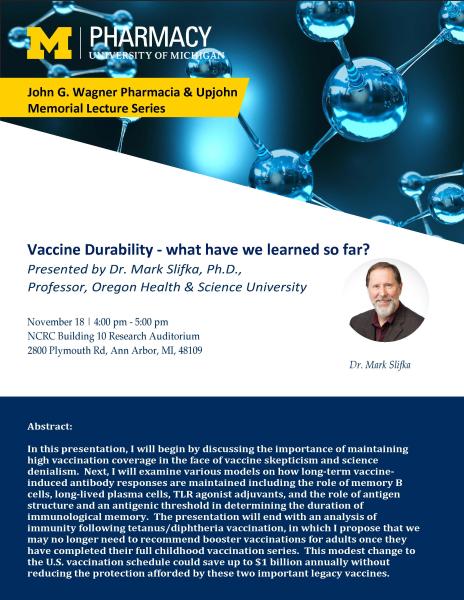

U-M College of Pharmacy Pharmaceutical Sciences John G. Wagner Pharmacia & Upjohn Memorial Lecture Series
Speaker: Dr. Mark Slifka, Ph.D.,
Professor, Oregon Health & Science University
Title: Vaccine Durability – what have we learned so far?
Abstract: In this presentation, I will begin by discussing the importance of maintaining high vaccination coverage in the face of vaccine skepticism and science denialism. Next, I will examine various models on how long-term vaccine-induced antibody responses are maintained including the role of memory B cells, long-lived plasma cells, TLR agonist adjuvants, and the role of antigen structure and an antigenic threshold in determining the duration of immunological memory. The presentation will end with an analysis of immunity following tetanus/diphtheria vaccination, in which I propose that we may no longer need to recommend booster vaccinations for adults once they have completed their full childhood vaccination series. This modest change to the U.S. vaccination schedule could save up to $1 billion annually without reducing the protection afforded by these two important legacy vaccines.
Related Links

Explore Similar Events
-
Loading Similar Events...
