Presented By: Department of English Language and Literature
Book Talk: Jarvis C. McInnis (Duke University)
Afterlives of the Plantation: Plotting Agrarian Futures in the Global Black South
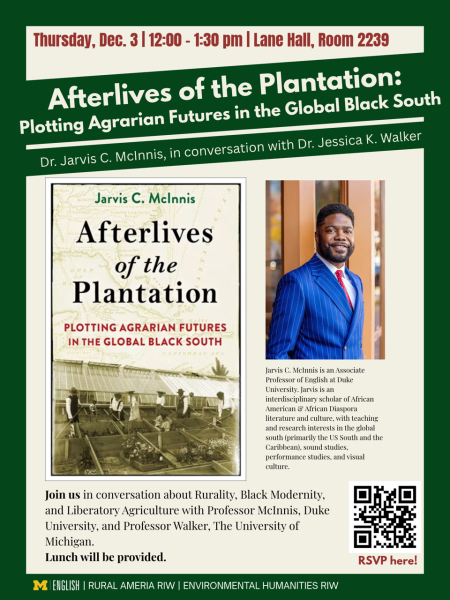

We’re excited to announce that the Rural America Rackham Interdisciplinary Workshop is hosting Jarvis C. McInnis, Professor of English at Duke University, for a talk on his new book, Afterlives of the Plantation: Plotting Agrarian Futures in the Global Black South (2026). Professor Jessica Kenyatta Walker, professor of Afroamerican and African Studies and American Culture, will lead the discussion following Dr. McInnis's presentation.
Please join us for an exciting discussion on Black modernity, Black history, rural and agrarian world making, and liberatory agriculture! Refreshments will be provided.
RSVP to the in-person event here: https://docs.google.com/forms/d/e/1FAIpQLSdsaGw2ARSOunEXYl1htGrXcrasZh4ON7jIz9Aj7Svb6TkNAA/viewform
The Rural America Rackham Interdisciplinary Workshop is sponsoring the event with assistance from the English Department and the Environmental Humanities Rackham Interdisciplinary Workshop.
About the book:
Built on the grounds of a former cotton plantation, the Tuskegee Institute, founded by Booker T. Washington, offered agricultural and industrial education as a strategy for Black self-determination. There—and in many other communities in the U.S. South, the Caribbean, and Central America—Black people repurposed and regenerated what had been a place of enslavement into a site for imagining alternative futures.
Jarvis C. McInnis charts a new account of Black modernity by centering Tuskegee’s vision of agrarian worldmaking. He traces the diasporic ties and networks of exchange that linked Black communities in the late nineteenth and early twentieth centuries. Although Washington is often regarded as an accommodationist, McInnis shows how artists, intellectuals, and political leaders—including George Washington Carver, Jean Price-Mars, Zora Neale Hurston, Claude McKay, and Marcus Garvey—adapted Tuskegee’s methods into dynamic strategies for liberation in places like Cuba, Puerto Rico, Haiti, and Jamaica. Even as the legacy of the plantation continued to circumscribe Black life, these thinkers found resources in its ruins to forge new theories and practices of progress, aesthetic innovation, and freedom that contributed to the New Negro Movement of the 1920s and 1930s.
In contrast to traditional understandings of Black modernity as urban and premised on northward migration, McInnis foregrounds rural settings and practices of place making, rootedness, and liberatory agriculture. Shedding new light on the transnational influence of a historically Black institution in the U.S. South, Afterlives of the Plantation remaps Black cultural, intellectual, and political histories down to the very soil. Columbia University Press
Related Links
Co-Sponsored By

Explore Similar Events
-
Loading Similar Events...
