Presented By: University Library
Black Muslim Refugee: Militarism, Policing, and Somali American Resistance to State Violence
with Dr. Maxamed Abu-maye
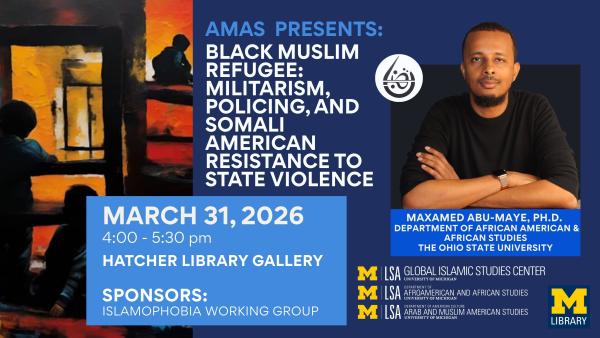

Maxamed Abu-maye, assistant professor in the Department of African American and African Studies at Ohio State University, speaks on his project, "Black Muslim Refugee: Militarism, Policing, and Somali American Resistance to State Violence."
This multi-sited project, the first of its kind, exposes the links between U.S. military violence abroad and police brutality at home through a profound exploration of Somali refugee lives. "Black Muslim Refugee" traces the globe-spanning journeys of these refugees, from civil war–era Somalia to the Dadaab refugee camp in Kenya to their eventual arrival in San Diego, and Abu-maye analyzes their experiences through the dual lenses of anti-Blackness and Islamophobia. He situates their displacement within the larger context of East Africa's colonial history, as well as the policy consequences of the American-backed war on terror and war on drugs. Throughout, Abu-maye's centering of Somali subjectivity underlines this community's critical and creative capacity to defy the mechanisms that seek to "manage" and ultimately control them.
Sponsored by the University of Michigan Library, Arab and Muslim American Studies, Department of Afroamerican and African Studies Studies, Global Islamic Studies Center, and the Islamophobia Working Group.
This multi-sited project, the first of its kind, exposes the links between U.S. military violence abroad and police brutality at home through a profound exploration of Somali refugee lives. "Black Muslim Refugee" traces the globe-spanning journeys of these refugees, from civil war–era Somalia to the Dadaab refugee camp in Kenya to their eventual arrival in San Diego, and Abu-maye analyzes their experiences through the dual lenses of anti-Blackness and Islamophobia. He situates their displacement within the larger context of East Africa's colonial history, as well as the policy consequences of the American-backed war on terror and war on drugs. Throughout, Abu-maye's centering of Somali subjectivity underlines this community's critical and creative capacity to defy the mechanisms that seek to "manage" and ultimately control them.
Sponsored by the University of Michigan Library, Arab and Muslim American Studies, Department of Afroamerican and African Studies Studies, Global Islamic Studies Center, and the Islamophobia Working Group.
Related Links

Explore Similar Events
-
Loading Similar Events...
