Presented By: Department of Linguistics
Linguistics MLK Colloquium
J. Michael Terry, University of North Carolina at Chapel Hill
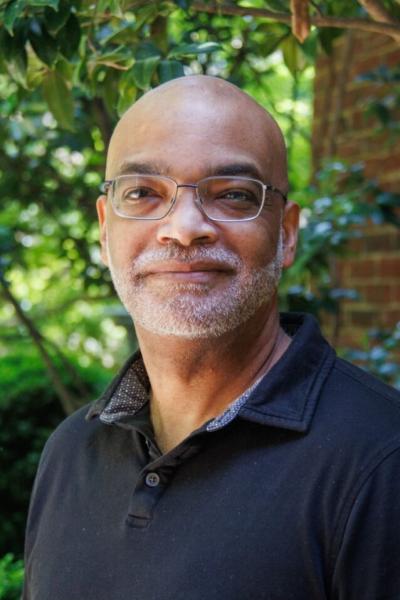

The 2027 Linguistics MLK Colloquium will occur on Friday, January 22, 2027, with J. Michael Terry as the speaker.
J. Michael Terry is an Associate Professor in the Department of Linguistics, and adjunct in the Department of African, African American, and African Diaspora Studies at the University of North Carolina at Chapel Hill. His work focuses on dialects of American English, especially African American English (AAE). Although he works primarily in tense and aspect semantics, his research employs a mix of methods that includes statistical analysis, formal modeling and EEG (brainwave) measurement techniques. He has written on the topics such as the semantics of AAE tense/aspect markers, single-speaker level language variation, quantifying the use of style-shift in African American adolescents, and, most recently, how dialectal differences can affect non-Mainstream English speaking 2nd graders’ performance on tests of mathematical reasoning.
Colloquium Title: What Speakers Do with Done: Pragmatics, Persistence, and Speaker Agency in African American English
Abstract: The social and grammatical structures that speakers inherit from their surroundings constrain how they express themselves. Neither, however, fully determines that expression, as neither social conditions nor grammar uses language. Speakers do. In making linguistic choices about what to say, when, and how, speakers simultaneously navigate the constraints these structures pose and draw on the resources they provide to make meaning.
Because linguists are typically less interested in speakers than in kinds of speakers, we abstract away from individual speaker choices to identify larger linguistic patterns: repeated uses of a marker or other linguistic resource that often perform shared social and grammatical functions.
Of particular interest are patterns that repeat across generations, regions, and social situations. Their persistence reinforces their associations with socially defined communities and classes of grammar based on structural similarities. This, in turn, provides constructs such as African American English (AAE) with relatively stable identities useful in a wide range of analytical pursuits.
African American use of the marker done in sentences like you done messed up plays a role in a number of such patterns. It has therefore figured prominently in characterizations of African American speech, with special attention often given to the marker’s use in expressing indignation and sass.
Rather than locate such meanings in the semantics of the marker itself, the analysis of AAE done developed in this talk assigns the marker a relatively abstract semantics based on stativity. It leaves many, if not most, of the meanings commonly associated with done to be derived pragmatically by speakers. These include not only richer affective interpretations, such as indignation, but more grammatical interpretations, such as recency and completion. Because pragmatic interpretation depends on what speakers do with markers in context, the analysis brings speaker choice into clear view. In doing so, it may also help explain the persistence of done in part as a matter of conversational utility.
By highlighting pragmatic choice in the use of this feature so strongly associated with African American language practices, the analysis aims to make visible the role of speaker agency in bringing social structure and grammatical organization together in actual language use.
Related Links

Livestream Information
ZoomJanuary 22, 2027 (Friday) 4:00pm
Meeting ID: 99774053256
Explore Similar Events
-
Loading Similar Events...
